Seoul K-Medi Center: KPop Demon Hunters Clinic Look-Alike
Walking from Jegi-dong Station Exit 2, touring the 1,000-won herbal medicine museum, and booking the foot bath and Bojewon experiences in Seoul
- Published:
- Last modified:
In mid-October 2026, I visited Seoul K-Medi Center in Jegi-dong.
The center is located in Seoul Yangnyeongsi, a traditional market where people buy and sell herbal medicine ingredients. It's close to the former site of Bojewon, an institution that cared for sick and poor commoners during the Joseon Dynasty.
The market was officially designated an herbal medicine market in 1995,
and today about 70% of the herbal medicine ingredients distributed in Korea are said to pass through here.
Seoul K-Medi Center is an easy walk from the subway station and has a Korean medicine museum you can tour for 1,000 won. An herbal foot bath, Bojewon Korean medicine treatments, traditional physician costume rental, and a Korean herbal cafe are all under the same roof.
Getting to Seoul K-Medi Center From Jegi-dong Station Exit 2
Jegi-dong Station on Subway Line 1 feels different the moment you're inside. Specimens of medicinal herbs and old pharmacy tools are displayed near the ticket gates, a clear sign that something related to herbal medicine is nearby.
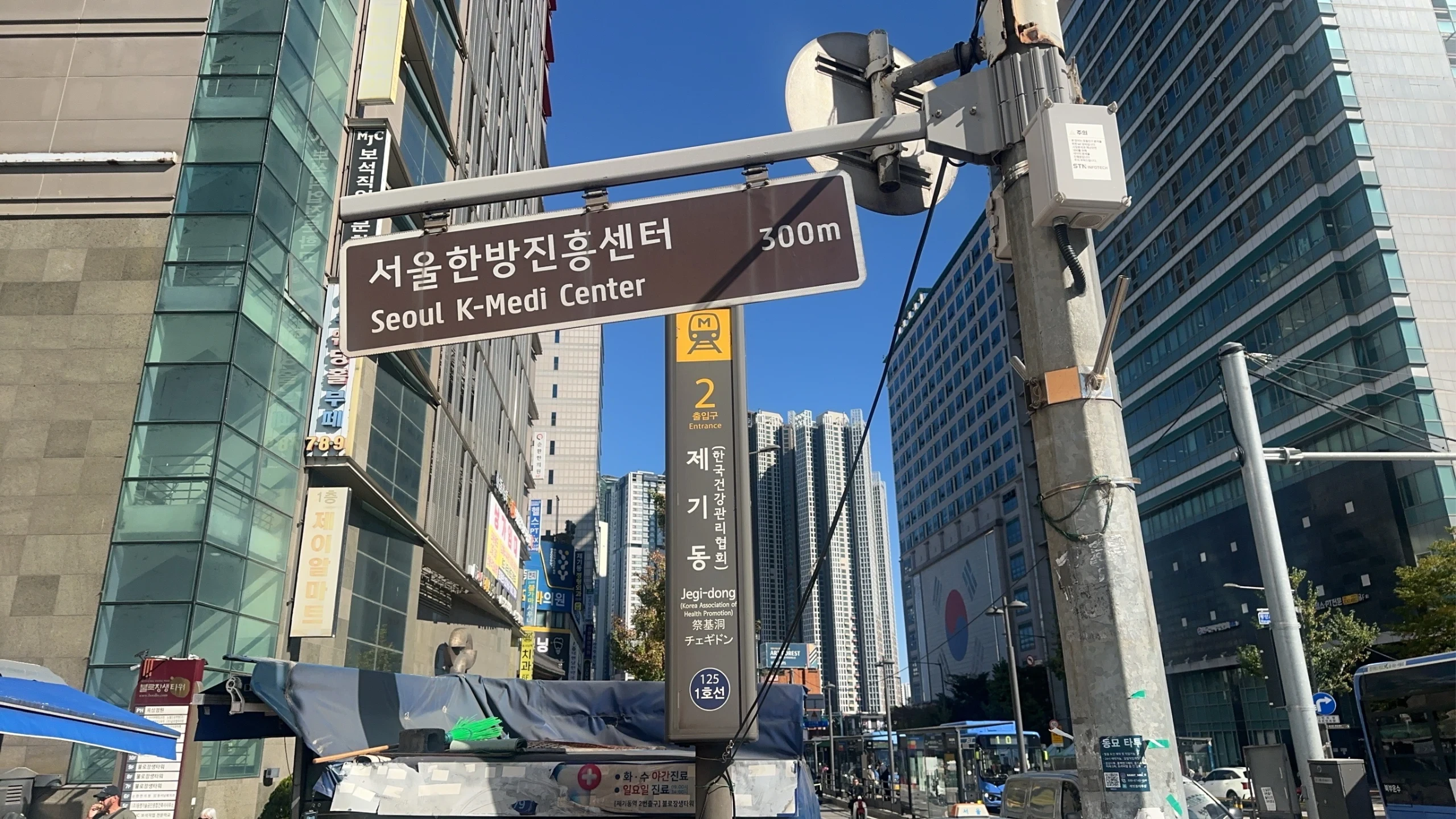
When you come out of Exit 2, you'll see a brown sign that reads "Seoul K-Medi Center 300m." Since it's in English as well, first-time visitors can find their way easily. The center is about 300–400 meters (roughly a quarter mile) from the exit, a five- to 10-minute walk. If you stroll slowly past the herb shops along the street, you can soak up the atmosphere of the herbal medicine market.
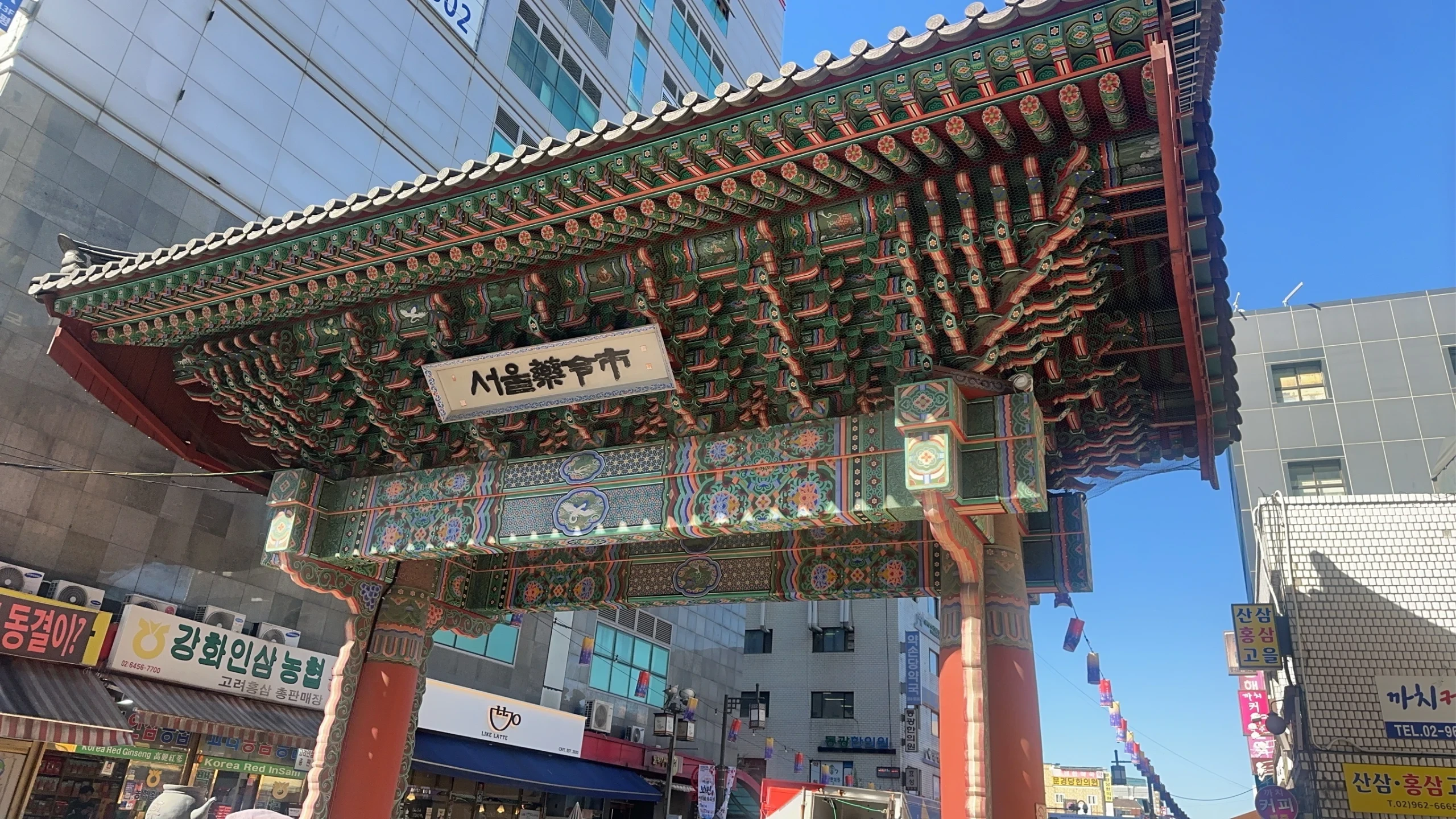
A little farther on, you'll reach a large traditional gate marked "Seoul Yangnyeongsi." Walk through it and keep going straight along the street lined with herb shops, and Seoul K-Medi Center will appear on your right. The faint scent of medicinal herbs follows you the whole way, so you also get a feel for a traditional Korean market.
Seoul K-Medi Center and Its Striking Hanok Roof
The first thing you notice when you arrive is the building's unusual look: a modern structure topped with a hanok (traditional Korean house) roof. The building became even more famous once people noticed it resembles the Korean medicine clinic in the Netflix animated film KPop Demon Hunters (known in Korea by the nickname "Kedeheon"). In the film, the main character Rumi visits a Korean medicine clinic when her voice won't come out properly, and word spread that the clinic's hanok exterior looks a lot like this place.
On the front lawn stands a large sculpture of an herbal medicine pot engraved with the character 藥 ("medicine"), and plenty of people were taking photos there dressed as old-time physicians and female physicians. You can try on the costumes in the Traditional Costume Room on the first floor, and the front desk can tell you how it works and when it's available.
A banner on the building's exterior also announced that it had been "Re-designated an Outstanding Wellness Tourism Destination for the Fourth Consecutive Time."
Starting Your Visit at the First-Floor Front Desk
Right inside the entrance are the front desk and a rack of brochures. Museum tickets and all the experience programs are handled here.
The lobby promotes programs such as the herbal foot bath and the Bojewon Korean medicine experience, and each one is paid for separately.
Brochures are available in several languages, including Korean, English, Chinese, and Japanese.
Even if you don't know Korean, it isn't hard to understand what's on each floor and which programs are offered.
Herbal Foot Bath and Bojewon Experience Times and Prices
The experience programs are posted in front of the front desk.
Experience Programs (Based on the Board at the Time of My Visit)
| Herbal foot bath | Bojewon Korean medicine experience | |
|---|---|---|
| Session times | 10:20 a.m., 11:00 a.m., 11:40 a.m., 1:20 p.m., 2:00 p.m., 2:40 p.m., 3:20 p.m., 4:20 p.m. | 11:00 a.m., 12:00 p.m., 2:00 p.m., 3:00 p.m., 4:00 p.m., 5:00 p.m. |
| Price | 6,000 won per tub (up to 2 people) | 5,000 won per person |
| Duration | About 20 minutes | About 30 minutes |
| Location | Foot bath room, 2nd floor | Bojewon, 3rd floor |
| Sign-up | First-come, first-served at the 1st-floor front desk | First-come, first-served at the 1st-floor front desk |
Up to two people can share one foot bath tub, so if you go as a pair it works out to about 3,000 won each.
Bojewon was the name of a Joseon Dynasty institution that cared for sick commoners, and today the name is used for a space where you can try treatments such as heat massage.
Museum admission is 1,000 won for adults,
and it's free for children age 6 and under, seniors 65 and over, and certain other groups. Experience times may change depending on the season and operating conditions.
A foot bath means soaking your feet in warm water, and it has a range of health benefits, including better circulation, muscle relaxation, and pain relief.
The foot bath room is on the second floor, with floor-to-ceiling glass on all sides that lets in plenty of sunlight. At each scheduled time, a staff member gathers the visitors, explains how it works, and then shows everyone in.
You can book the herbal foot bath and the Bojewon Korean medicine experience online in advance.
Just scan the QR code on the notice or go to the booking menu on the official website.
Same-day reservations aren't accepted, so once your travel dates are set, it's best to book by the day before.
Online booking mostly covers weekends and public holidays, while weekdays are often first-come, first-served on site. Popular time slots can fill up early, so I'd recommend signing up at the desk as soon as you arrive and then touring the museum.
Farther inside the first floor is a scale model of the Bojewon building, with a description titled "Bojewon, a Symbol of Compassion for the People and Public Relief."
Behind it is the Traditional Costume Room, where you can try on old-time physician's clothing.
Exploring the Seoul Yangnyeongsi Herb Medicine Museum on the Second Floor
Head up to the second floor and you'll find the Seoul Yangnyeongsi Herb Medicine Museum. Starting with the sign at the entrance, everything is written in both Korean and English, so foreign visitors can get around the exhibits without trouble.
The first room uses panels arranged by era to show how Korean medicine began and developed.
You can also learn the history of the Yangnyeongsi market you just walked through. A timeline traces how a market that began when herbal medicine merchants gathered near Bojewon in the Joseon era grew into today's large herbal medicine market. Thinking back on the street I had just walked made it even more interesting.
There's also a faithful re-creation of an old herbal pharmacy. Looking at the cabinets with dozens of herb drawers, the stone mortars, and the herbs hanging on the wall, it's easy to picture what a Korean medicine clinic used to look like.
The medicinal herb exhibit has the most to see in the whole museum. You can get a close look at ingredients like licorice root, cinnamon bark, ginseng, jujubes, and ginger—names you may have heard but never actually seen. If you've been wondering what the herbs sold in the market are, it's a good idea to look around here first and then explore the market.
There's also a model of an old village where people grew and gathered medicinal herbs. Alongside it, you can read how the harvest time differs depending on whether the useful part is the root, stem, flower, or seed.
Yin-yang and the five elements, the foundation of Korean medicine, are also explained clearly with illustrations.
Yin-yang and the five elements (陰陽五行) is a fundamental principle of Eastern philosophy that explains how all things in the universe arise and change, as well as the human cycle of birth, aging, illness, and death. It's widely used in Korean medicine, myeongni (Four Pillars of Destiny fortune-telling), and feng shui.
It's the idea that five energies—wood, fire, earth, metal, and water—support and check one another to stay in balance, and it helps you understand how traditional Korean medicine views the body.
The most fun part is the Sasang constitution diagnosis corner. Sasang constitutional medicine is a uniquely Korean theory that divides people into four body types: Taeyangin, Taeeumin, Soyangin, and Soeumin. Tap the kiosk screen and answer the questions to find out your type. It also supports English, Chinese, and Japanese, so foreign visitors can easily give it a try.
It's a self-assessment just for fun, so for an accurate diagnosis, I recommend visiting a Korean medicine clinic.
Finally, there's a true-or-false quiz corner that tests your knowledge of Korean medicine. It's a nice way to check what you picked up from the exhibits.
A Hanok Cafe Serving Korean Herbal Teas
The center also has a Korean herbal cafe built in hanok style.
For a meal, there's a lunch special lotus leaf rice set (seven side dishes plus soup) and lotus leaf rice on its own,
and the herbal teas include ssanghwa-cha (a traditional tonic tea), sipjeon daebo-cha (ten-herb tonic tea), jujube tea, and ginseng tea. The menu items are also written in English, so foreign visitors can order easily. It's a good spot to rest after the programs or to try traditional Korean tea for the first time.
Seoul K-Medi Center Basic Information
| Item | Details |
|---|---|
| Address | 26 Yangnyeongjungang-ro, Dongdaemun-gu, Seoul (서울 동대문구 약령중앙로 26) |
| Getting there | About 300–400 meters from Exit 2 of Jegi-dong Station, Subway Line 1; a 5–10 minute walk |
| Hours | Summer (March–October) 10:00 a.m.–6:00 p.m. / Winter (November–February) 10:00 a.m.–5:00 p.m.; last entry 30 minutes before closing |
| Prices | Museum admission 1,000 won / Herbal foot bath 6,000 won per tub (up to 2 people) / Bojewon Korean medicine experience 5,000 won per person |
| Reservations | Experience programs can be booked online (no same-day booking); on-site sign-up is first-come, first-served at the 1st-floor front desk |
| Parking | Paid; 500 won for the first 10 minutes, 3,000 won for each additional 60 minutes, up to 15,000 won |
| Amenities: | Groups welcome, separate men's and women's restrooms, waiting area, wheelchair-accessible entrance and restrooms, accessible parking spaces |
| Phone | 02-969-9241 |
| Website | Loading link preview... |
※ Closing days and experience times may change, so I recommend checking the notices on the official website or calling before you go.
Final Thoughts
Seoul K-Medi Center is within walking distance of the subway, and it lets you see and experience traditional Korean medicine for very little money.
From the herb exhibits to the Sasang constitution kiosk, there was plenty to see, and the multilingual signage is well done, so it was an easy place for foreign travelers too.
If you want to try the foot bath or the Bojewon experience, it's best to book online by the day before or to arrive right when it opens. Afterward, I recommend making a route of it by exploring Seoul Yangnyeongsi and nearby Gyeongdong Market as well.
Visitor guide
Getting there
Seoul K-Medi Center (서울한방진흥센터)
26 Yangnyeongjungang-ro, Dongdaemun-gu, Seoul
Choose your starting station to see which train to take and where to transfer.
Jegi-dong Station Exit 2
Come out of Jegi-dong Station Exit 2 and walk straight for 100 meters.
Jegi-dong Station Exit 2 Seoul Yangnyeongsi Sign
Turn left onto the street where you can see the Seoul Yangnyeongsi gate, then walk straight for 300 meters.
Seoul Yangnyeongsi gate
More posts by Jounmaker
- Jjamppong Jijon Dunsan Daejeon: Buka 24 Jam, Kuah SmokyIndonesian Indonesia
- 韓國大田肯德基屯山店:凌晨4點也開著,辣味脆雞與英文點餐機心得Chinese Taiwan
- KFC Daejeon Dunsan alle 4: Hot Crispy Chicken senza filaItalian Italy
- 대전 신탄진 베이커리 카페 NTBR 방문 후기, 레스큐어 버터 빵과 시그니처 오렌지 라떼Korean South Korea
- Flâner178, Daejeon: latte cu cremă de porumb și potecăRomanian Romania




Explore articles in other languages.